


Executive Summary
To thrive in a volatile market, organizations must move beyond “order-taking” Business Analysis. The modern BA is the Strategic Navigator of the firm—leveraging value-stream mapping and data-driven synthesis to ensure that every technical sprint delivers measurable operational excellence and aligns with North Star metrics.
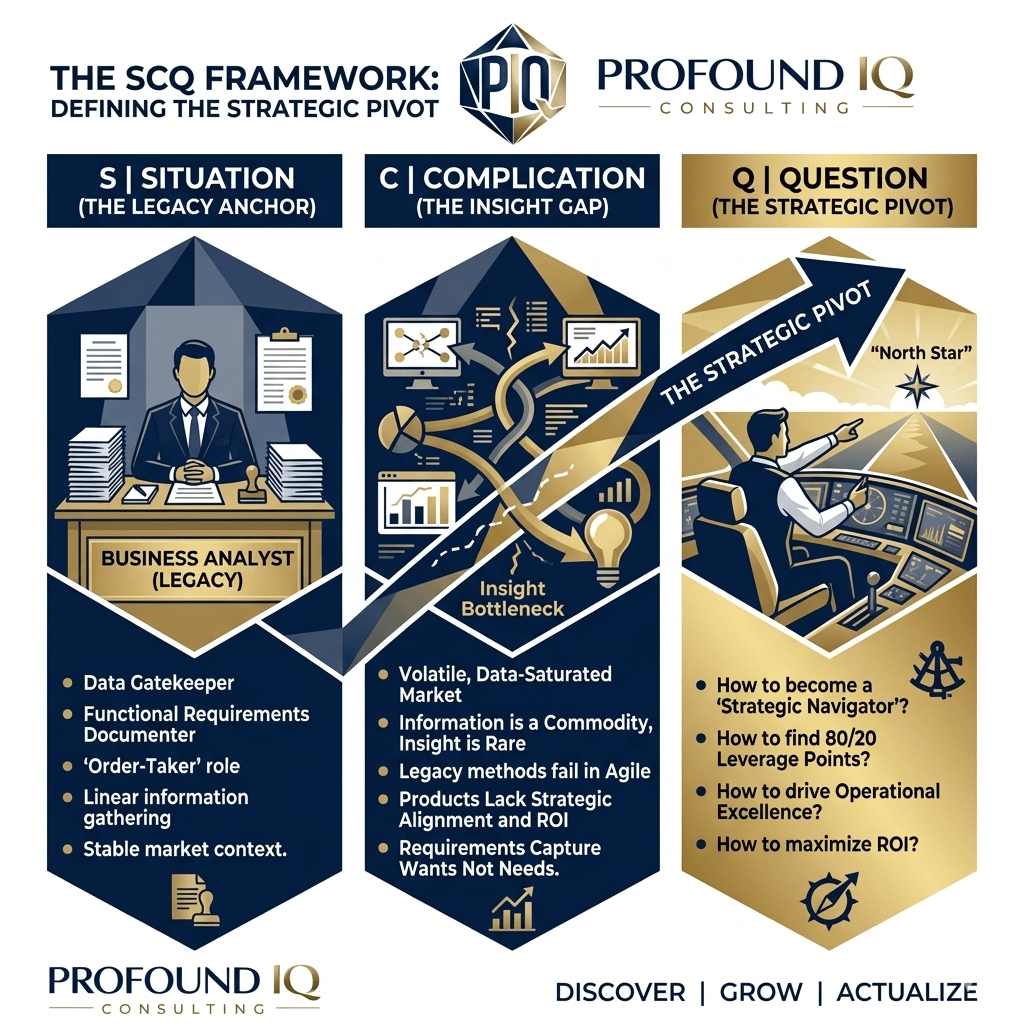
Traditionally, the Business Analyst (BA) has functioned as the primary “Data Gatekeeper.” In this legacy model, the role was defined by linear information gathering—acting as a conduit between business stakeholders and technical teams. The BA’s success was measured by the volume and precision of functional requirements documents (FRDs). For years, this “order-taker” approach provided stability in environments where market shifts were predictable and technical delivery cycles were long.
The modern business landscape is no longer linear; it is volatile and data-saturated. We have reached a point where information gathering is a commodity, but insight synthesis is a rarity. The complication arises when organizations continue to use legacy BA methodologies in an Agile, digital-first world:
Requirements vs. Reality: Stakeholders often misdiagnose their own pain points, requesting “features” that don’t address the root cause.
Friction and Waste: Following a “Gatekeeper” mindset leads to building technically sound products that offer zero strategic alignment or market value.
The Velocity Trap: In Scrum/Agile environments, a traditional BA becomes a bottleneck, failing to provide the speed and “Three-Lens” perspective (Desirability, Viability, Feasibility) required for high-impact delivery.
How does the organization transition the Business Analysis function from a passive documentation engine into a “Strategic Navigator”—an engine room of transformation that identifies the 80/20 leverage points to drive operational excellence and maximize ROI?
Consultant Call-out: The “So What?” Test
Pro-Tip: Before moving from the Question to the Solution, apply the Pyramid Principle. A Strategic Navigator never presents data without an accompanying insight. Every observation must pass the “So What?” test: Does this insight directly influence our North Star metrics or mitigate a critical risk? If not, it is noise, not intelligence.
The legacy BA focused on the “What” (Functional Requirements). The Modern BA focuses on the “How and Why” (Value-Stream Mapping).
Legacy Approach: Compiling exhaustive lists of software features. This often results in “Local Optimization”—making a broken process slightly faster without fixing the root cause.
Modern Approach: Identifying the end-to-end flow of value to the customer. By mapping the value stream, the BA identifies “waste” and “friction” points before a single line of code is written.
Consultant Call-out: Leveraging Synergies. Stop asking “What should the system do?” and start asking “Where does value leak in our current process?” A 5% reduction in value-stream friction often yields a higher ROI than a 50% increase in feature count.
The legacy approach to Business Analysis fails in the modern enterprise because it prioritizes Output (Documentation) over Outcome (Value). By operating as a “Data Gatekeeper,” the traditional BA inadvertently creates siloed solutions that optimize local functions while degrading the global value stream.
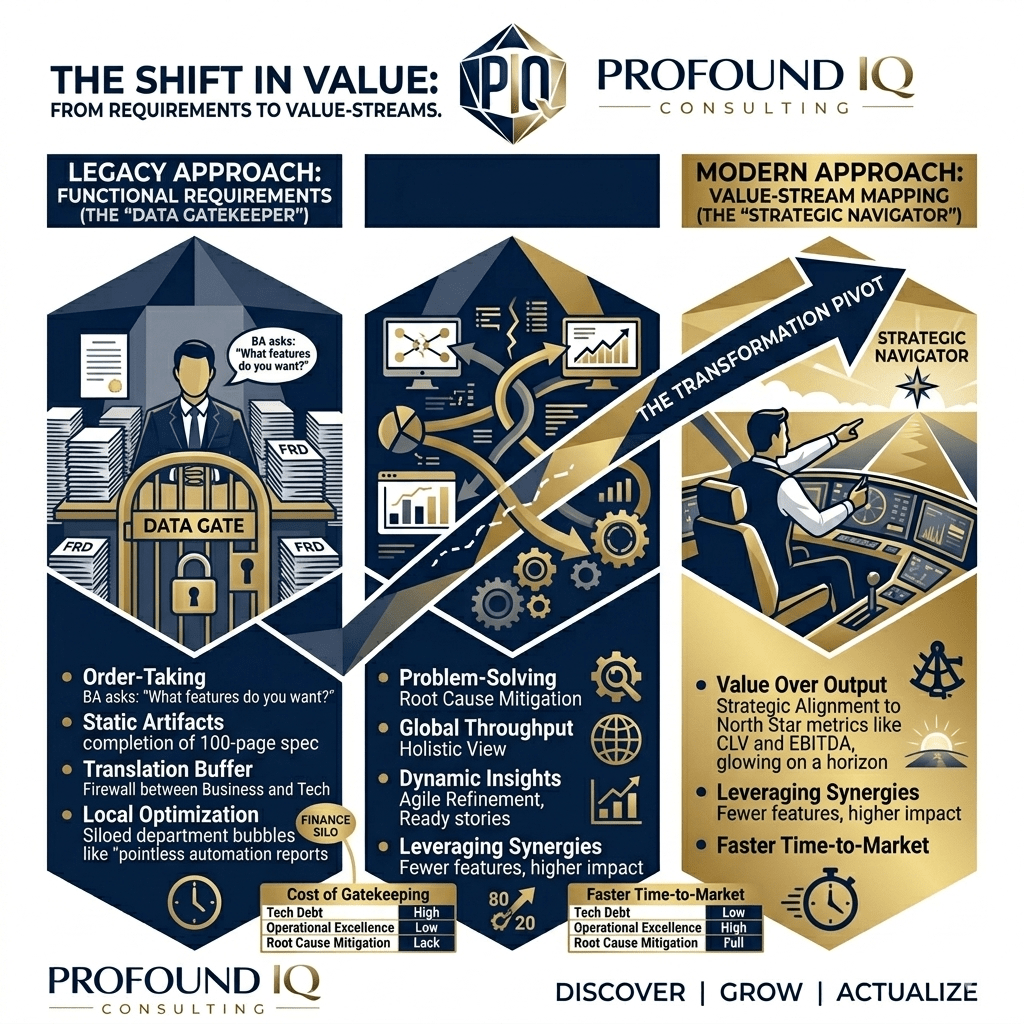
In the traditional consulting model, the Business Analyst was the custodian of the Functional Requirements Document (FRD). This role was defined by a “Post Office” mentality—collecting requests from the business and delivering them to IT with minimal synthesis.
Order-Taking vs. Problem-Solving: The BA asks, “What features do you want?” rather than “What business friction are we trying to mitigate?”
Static Artifacts: Success is measured by the completion of a 100-page requirement spec. These documents are often obsolete by the time they are signed off due to market volatility.
The Translation Buffer: The BA acts as a firewall between the Business and Tech. While intended to provide clarity, this often creates a “Lost in Translation” effect where technical feasibility is never balanced against customer desirability.
When a BA focuses strictly on requirements gathering, the organization suffers from Strategic Drift. Requirements are often a collection of “wants” from the loudest stakeholders, rather than the “needs” of the value stream.
Local Optimization (The Silo Trap): A legacy BA might help the Finance department automate a specific report, saving three hours of manual work. However, if that report is never read by the Executive team, the ROI is zero.
Feature Bloat: Without the 80/20 Rule, legacy BAs capture every “edge case” requirement. This results in complex, over-engineered systems where 80% of the features are rarely used, yet drive 100% of the technical debt.
The Requirement “Hand-off” Friction: In this model, the BA finishes their work before the Dev team starts. This creates a waterfall-style disconnect where the people building the solution have no context regarding the North Star metrics the solution is meant to move.
Legacy analysis is an expensive insurance policy that rarely pays out. By the time a “Gatekeeper” validates a requirement, the opportunity cost has already peaked.
| Feature | Legacy Approach (Gatekeeper) | Economic Consequence |
| Focus | Functional Specification | High Technical Debt |
| Success Metric | Sign-off on Documentation | Low Operational Excellence |
| Data Usage | Historical reporting | Lack of Root Cause Mitigation |
| Speed | Linear/Sequential | Slow Time-to-Market |
Consultant Call-out: The “Transcription” Tax
Pro-Tip: If your Business Analysts are simply transcribing what stakeholders say into a Jira ticket or an FRD, you are paying a “Transcription Tax.” A high-value BA must challenge the premise of the request. If the stakeholder asks for a “faster horse,” the Strategic Navigator investigates the need for “shorter travel time.” Stop documenting desires; start mapping value.
The Modern Business Analyst—the Strategic Navigator—replaces the documentation of “Features” with the optimization of “Flow.” By pivoting from functional requirements to Value-Stream Mapping (VSM), the BA identifies the high-leverage 20% of process friction that inhibits 80% of organizational throughput, ensuring every technical intervention drives operational excellence.
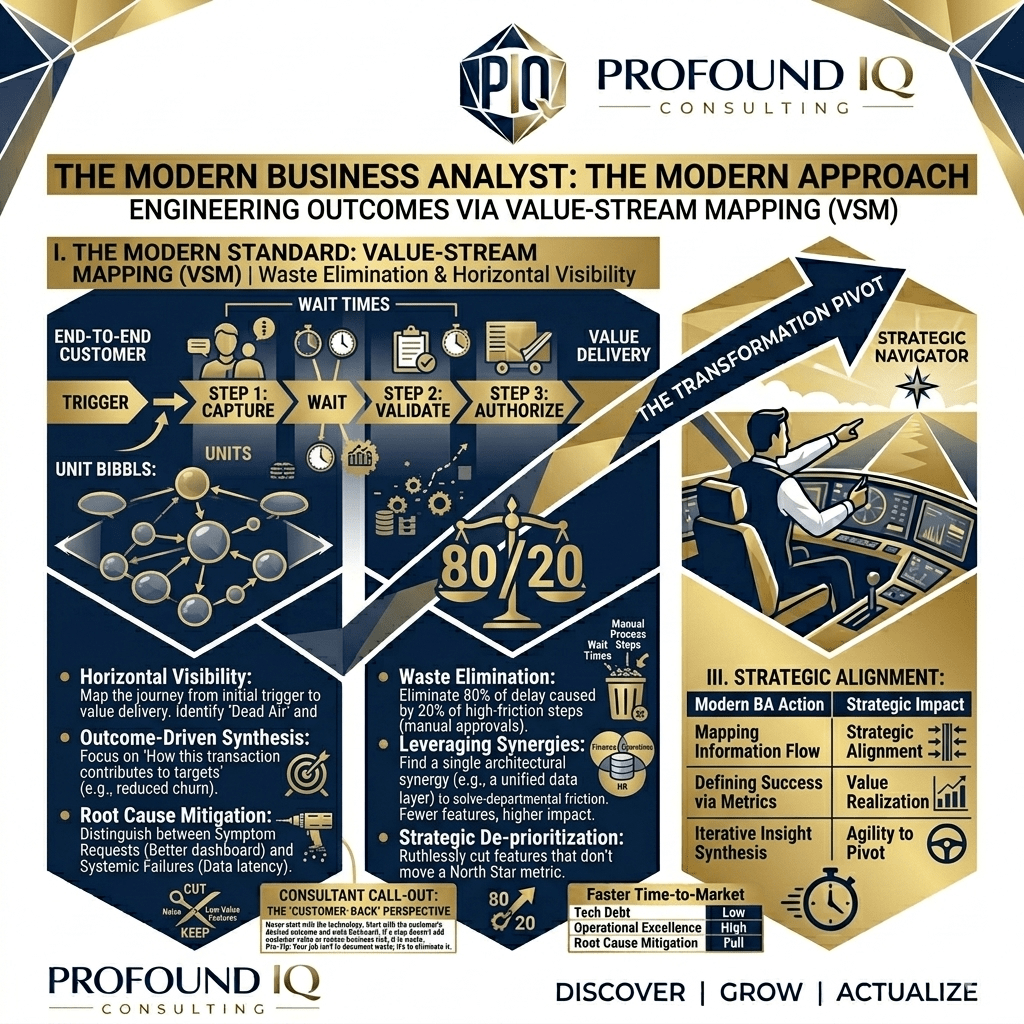
Unlike the legacy approach that looks at software in a vacuum, the modern BA views the organization as a series of interconnected pipes through which value flows to the customer.
Horizontal Visibility: The BA maps the journey from the initial customer trigger to the final value delivery. They look for “Dead Air”—the wait times and hand-off frictions where value stagnates.
Outcome-Driven Synthesis: Instead of asking, “How should this button work?” the Navigator asks, “How does this transaction contribute to our target for reduced churn?”
Root Cause Mitigation: Modern BAs use data to distinguish between “Symptom-Level Requests” (e.g., “We need a better dashboard”) and “Systemic Failures” (e.g., “Our data latency is 48 hours, making any dashboard irrelevant”).
A Strategic Navigator recognizes that not all business problems are created equal. They apply the 80/20 Rule to the Value-Stream to maximize ROI.
Waste Elimination: In any given process, 80% of the delay is usually caused by 20% of the steps (often manual approvals or data re-entry). The BA targets these “Value-Leaks” first.
Leveraging Synergies: Instead of building custom features for five different departments, the Navigator identifies a single architectural “synergy”—such as a unified customer data layer—that solves 80% of the cross-departmental friction.
Strategic De-prioritization: If a requirement does not move a North Star metric, it is ruthlessly cut. The Modern BA protects the development team from the “noise” of low-value features.
Operational excellence is achieved when the “Engine Room” (Technical Teams) is perfectly synced with the “Bridge” (Executive Strategy).
| Modern BA Action | Strategic Impact |
| Mapping Information Flow | Identifies silos and enables strategic alignment. |
| Defining Success via Metrics | Shifts the focus from “Project Completion” to “Value Realization.” |
| Iterative Insight Synthesis | Provides the business with the agility to pivot based on real-world data. |
Consultant Call-out: The “Customer-Back” Perspective
Pro-Tip: Never start your analysis with the technology. Start with the customer’s desired outcome and work backward through the Value-Stream. If a step in your requirements doesn’t clearly add value to the end customer or reduce a business risk, it is waste. Your job isn’t to document the waste; it’s to eliminate it.
By moving to a Modern Approach, the BA ceases to be a cost center and becomes a value-multiplier. They ensure that the organization isn’t just “doing things right” (efficiency), but is “doing the right things” (effectiveness).
Sustainable transformation is not an act of technical delivery; it is an act of Strategic Equilibrium. A Modern Business Analyst acts as the “Architect of Balance,” ensuring every initiative sits at the precise intersection of Desirability, Viability, and Feasibility. Ignoring any single lens creates a “Value Leak” that can jeopardize the entire investment.

The Strategic Navigator uses these three lenses to filter every requirement, feature, and process change. This ensures the organization doesn’t just build things right, but builds the right things.
The Core Question: Does this solve a high-friction “Job-to-be-Done” for the end-user?
The Navigator’s Focus: Beyond mere “user requests,” the BA synthesizes behavioral data to identify latent needs. They look for the 20% of user experience improvements that will drive 80% of customer satisfaction.
Strategic Risk: High technical feasibility but low desirability leads to “Ghost Products”—expensive software that no one uses.
The Core Question: Does this align with our North Star metrics and drive long-term operational excellence?
The Navigator’s Focus: This is where the BA acts as a Value-Engineer. They calculate the ROI, assess the impact on EBITDA, and ensure the initiative supports the broader corporate strategy. They ask: “Does this move us closer to our 5-year goal, or is it a tactical distraction?”
Strategic Risk: High desirability but low viability leads to “Value Destruction”—products that customers love but the business cannot afford to sustain.
The Core Question: Can we execute this within our current architecture and operational capacity without incurring crippling technical debt?
The Navigator’s Focus: The BA translates business ambitions into technical reality. They evaluate “Buy vs. Build” scenarios and identify whether a solution requires a “Rip and Replace” strategy or if we can leverage synergies within the existing tech stack.
Strategic Risk: High viability and desirability but low feasibility leads to “The Execution Gap”—ambitious strategies that crumble during implementation.
In a high-velocity environment, these three lenses are often in conflict. The Business Analyst must use Influence Without Authority to manage stakeholder friction and drive consensus.
The Innovation Sweet Spot: The rare intersection where a solution is loved by users, profitable for the business, and elegantly executable.
Root Cause Mitigation: When a conflict arises (e.g., Business wants a feature that Tech says is impossible), the BA doesn’t just “document the roadblock.” They re-examine the Value-Stream to find a middle ground that preserves the core outcome while easing technical friction.
A common pitfall is trying to maximize all three lenses simultaneously, which leads to “Analysis Paralysis.” The Modern BA identifies the critical trade-offs:
Prioritize the “Critical Few”: Identify the 20% of features that meet the highest standards across all three lenses.
The “Good Enough” Feasibility: Sometimes a 100% viable and desirable solution only needs 80% feasibility to launch as an MVP (Minimum Viable Product).
Ruthless Pruning: If an initiative fails the “Viability” test, the Navigator has the authority of data to recommend its termination, even if it is technically feasible and highly desired.
Consultant Call-out: The “Anti-Pattern” Alert
Pro-Tip: Beware the “Golden Feature” trap. This happens when a high-ranking stakeholder demands a feature that is Viable (in their eyes) and Desirable (for their specific silo) but technically Infeasible (destroys the architecture). Your role is to pivot the conversation back to the Value-Stream. Ask: “What is the specific North Star metric this feature moves?” Often, the “Golden Feature” is just an expensive symptom of an unmapped process.
In a high-velocity Agile environment, speed without direction is merely “expensive motion.” The Modern Business Analyst—the Strategic Navigator—serves as the Engine Room of the Scrum, converting high-level product visions into executable, high-value technical increments. By acting as the “Strategic Glue” between the Product Owner (PO) and the Development Team, the BA ensures that agility never compromises strategic alignment.
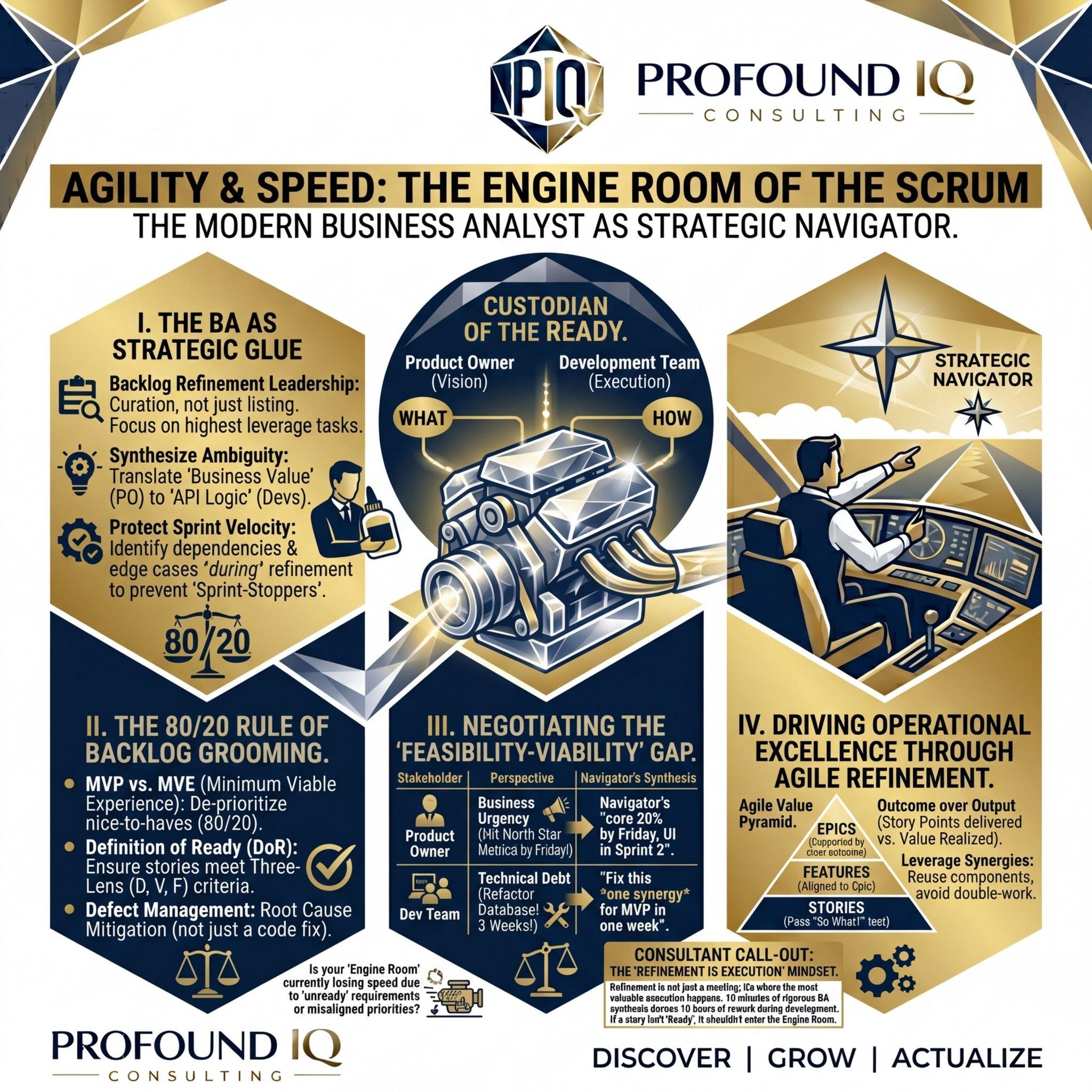
While the Product Owner (PO) focuses on the “What” and the “When” (Market Vision), and the Development Team focuses on the “How” (Execution), the BA is the custodian of the “Ready.”
Backlog Refinement Leadership: The BA doesn’t just manage a list; they curate a Value-Stream. They ensure every user story is decomposed to its most impactful 20%, ensuring the team is always working on the highest-leverage tasks.
Synthesizing Ambiguity: POs often speak in “Business Value.” Developers speak in “API endpoints.” The BA translates these disparate languages into a unified logic that ensures operational excellence.
Protecting Sprint Velocity: By identifying dependencies and edge cases during refinement, the BA prevents “Sprint-Stoppers”—those mid-cycle realization moments that destroy momentum.
A Navigator knows that a bloated backlog is a symptom of poor strategy. They apply the 80/20 Rule to maximize the team’s “Value Density.”
MVP vs. MVE (Minimum Viable Experience): The BA identifies the 20% of features that will satisfy 80% of the customer’s “Job-to-be-Done.” This prevents the “Featurism” that often leads to technical debt.
Definition of Ready (DoR): A BA ensures that a story only enters a sprint when it is fully “Ready.” This means it has met the Three-Lens criteria: Is it Desirable, Viable, and technically Feasible?
Root Cause Mitigation in Defect Management: When bugs arise, the BA doesn’t just log a ticket. They investigate the root cause within the value stream to see if a process change—rather than a code fix—is the more sustainable solution.
The most significant point of failure in modern transformation is the “Execution Gap”—where business ambition (Viability) outstrips technical reality (Feasibility). The Modern Business Analyst—the Strategic Navigator—does not merely report this gap; they close it through Value Engineering. By applying the 80/20 Rule to technical constraints, the Navigator identifies the “Minimum Viable Path” to achieving North Star metrics without compromising operational excellence.
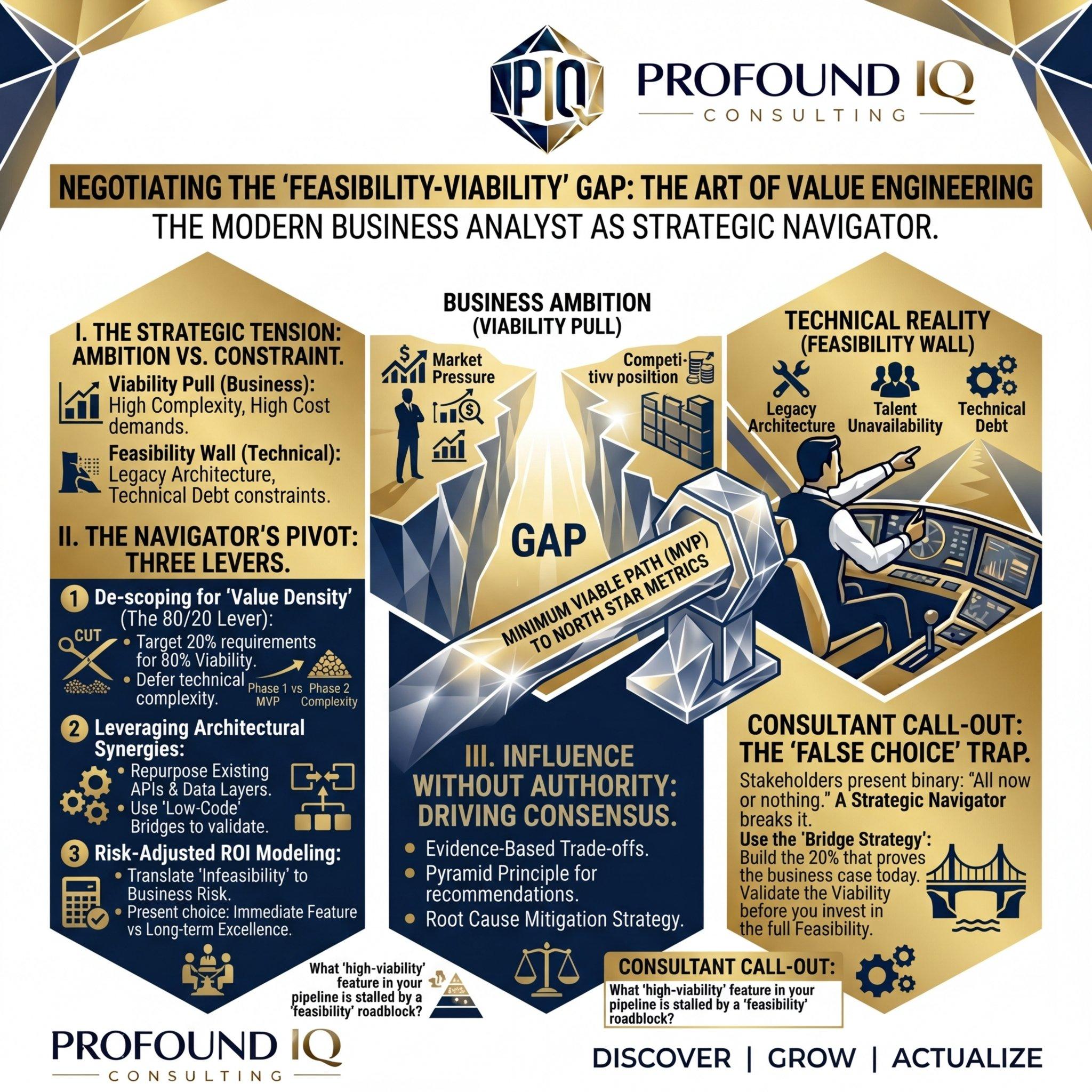
In every high-stakes project, two primary forces exist in natural opposition. The Navigator’s role is to synthesize these forces into a singular roadmap.
The Viability Pull (Business): Driven by market pressure, competitive positioning, and the need for ROI. The business often demands “total solutions” that are high-complexity and high-cost.
The Feasibility Wall (Technical): Constrained by legacy architecture, talent availability, and technical debt. Technical teams often push for “long-term stability,” which can lead to delayed time-to-market.
When the gap appears, a “Gatekeeper” says “No.” A Strategic Navigator applies three specific levers to move the project forward.
Most business requirements follow a power-law distribution. The Navigator identifies the 20% of functional requirements that deliver 80% of the Viability.
The Action: Ruthlessly prune features that add 50% to the technical “Feasibility” cost but only move a North Star metric by 2%.
The Goal: Launch a “Lean-Viable” solution that captures immediate value while deferring technical complexity to Phase 2.
Instead of building bespoke solutions (High Friction), the Navigator identifies existing technical synergies.
The Action: Repurpose an existing API, leverage an enterprise-wide data layer, or use a “low-code” bridge to validate a concept.
The Goal: Lower the Feasibility barrier by using what the organization already owns, accelerating strategic alignment.
The BA must translate technical “Infeasibility” into business “Risk.”
The Action: Present the “Cost of Complexity.” Show how a specific high-viability feature will increase long-term technical debt by a specific factor.
The Goal: Drive executive consensus by presenting a choice between “Immediate Feature Delivery” and “Long-term Operational Excellence.”
Negotiating the gap requires moving stakeholders from emotional “wants” to empirical “needs.”
Evidence-Based Trade-offs: Use the Pyramid Principle to present a recommendation.
Top: “We should defer the real-time sync feature to Q3.”
Middle: “Doing so reduces technical complexity by 40% (Feasibility) while still capturing 90% of the projected revenue (Viability).”
Base: Supporting data on user behavior and current architectural bottlenecks.
Root Cause Mitigation: If the “Feasibility” barrier is a lack of data cleanliness, the Navigator doesn’t ask for a “better database.” They propose a Root Cause Mitigation strategy to clean the data at the source, making future features feasible.
Consultant Call-out: The “False Choice” Trap
Pro-Tip: Stakeholders will often present a false choice: “Build it all now or don’t build it at all.” As a Strategic Navigator, your job is to break that binary. Use the “Bridge Strategy”: Build the 20% that proves the business case today, using a manual workaround (high feasibility/low cost) to handle the 80% o
Operational excellence in Agile is not achieved during the Sprint; it is engineered during Refinement. The Modern Business Analyst—the Strategic Navigator—transforms refinement from a tactical “ticket review” into a high-stakes Insight Synthesis session. By applying the Pyramid Principle to backlog health and ruthlessly enforcing the 80/20 Rule, the Navigator ensures the “Engine Room” only processes high-density value, eliminating waste before it enters the development cycle.
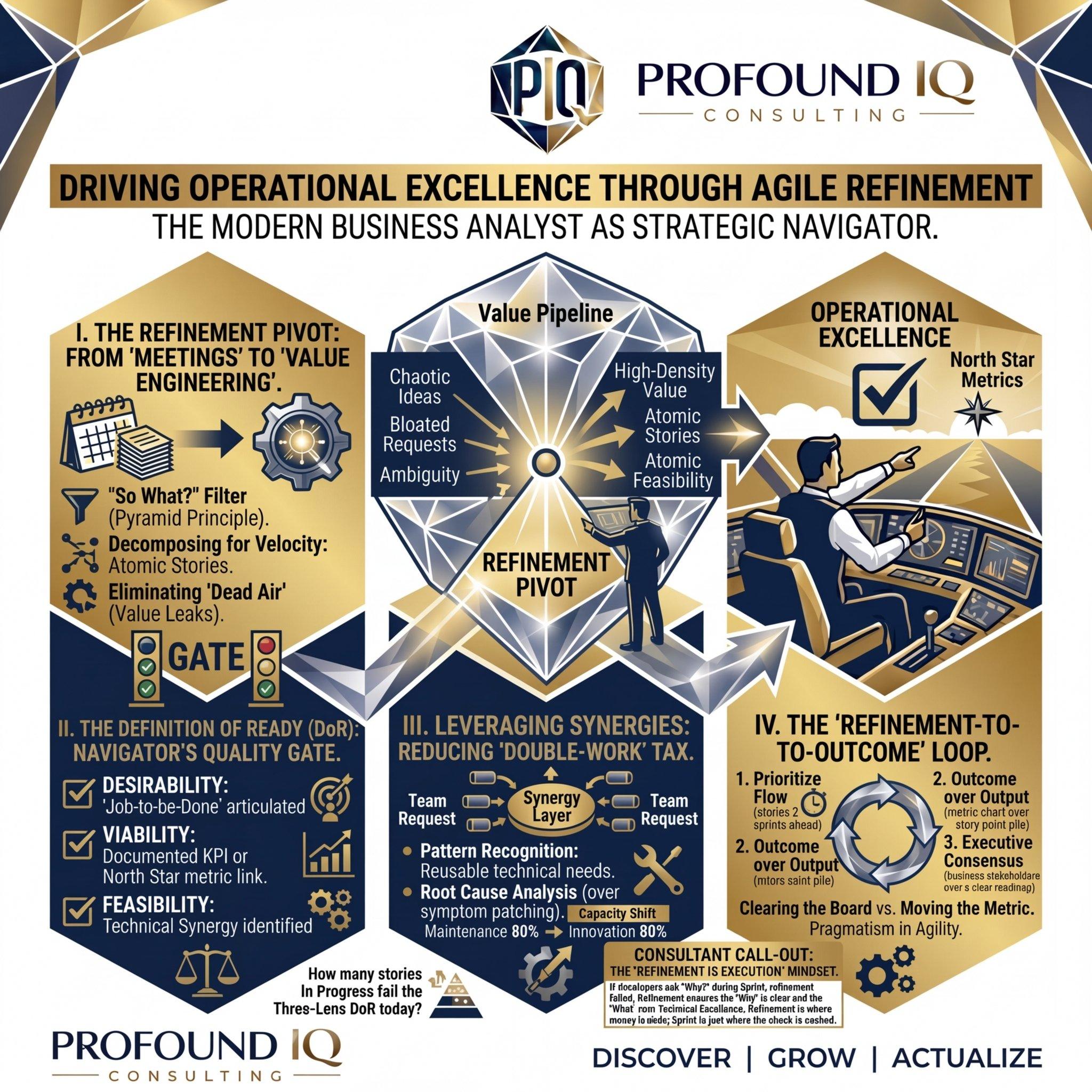
In the legacy model, refinement is often an afterthought. In the Profound IQ model, refinement is the primary driver of strategic alignment.
The “So What?” Filter: The Navigator subjects every user story to the Pyramid Principle. If a story cannot be mapped to a supporting pillar of a strategic Epic, and that Epic doesn’t point to a North Star metric, the story is discarded.
Decomposing for Velocity: Operational excellence requires breaking down complex “Monolith” requirements into “Atomic” stories. The goal is to find the 20% of the functionality that yields 80% of the impact, allowing for faster release cycles.
Eliminating “Dead Air”: The BA identifies “Value Leaks”—requirements that add technical complexity without enhancing the customer journey—and prunes them during the refinement phase.
Operational excellence is impossible if the “Engine Room” is fed ambiguous inputs. The Strategic Navigator enforces a rigorous DoR based on the Three-Lens Analysis.
| Criteria | The Navigator’s Checklist | Objective |
| Desirability | Is the “Job-to-be-Done” clearly articulated for the end-user? | Customer Centricity |
| Viability | Is there a documented link to a KPI or North Star metric? | Strategic Alignment |
| Feasibility | Has the technical “synergy” been identified with the Dev team? | Technical Efficiency |
A key component of operational excellence is the identification of cross-functional synergies during refinement.
Pattern Recognition: The Navigator looks across the backlog to find recurring technical needs. Instead of five different stories requiring five different API calls, the BA proposes a single, reusable “Synergy Layer.”
Root Cause Mitigation: If a backlog is filled with “Maintenance” stories, the Navigator pauses to perform a Root Cause Analysis. They move the team from “patching symptoms” to “engineering out the flaw,” shifting the team’s capacity from 80% maintenance to 80% innovation.
The Modern BA ensures that “Agility” is balanced with “Pragmatism.” They use the 80/20 Rule to protect the team’s cognitive load.
Prioritize Flow: Ensure that the most valuable stories are refined 2 sprints in advance, creating a “Value Buffer.”
Outcome over Output: During refinement, the BA re-centers the team on the Outcome. Success isn’t “clearing the board”; it’s “moving the metric.”
Executive Consensus: Use the refined backlog as a visual roadmap to show stakeholders exactly how operational excellence is being built, one high-value increment at a time.
Consultant Call-out: The “Refinement is Execution” Mindset
Pro-Tip: If your developers are asking “Why are we building this?” during the Sprint, your refinement process has failed. As a Strategic Navigator, your job is to ensure the “Why” is so clear and the “What” is so lean that the Sprint becomes a pure exercise in Technical Excellence. Refinement is where the money is made; the Sprint is just where the check is cashed.
In a polarized and hyper-volatile business environment, the Modern Business Analyst—the Strategic Navigator—must move beyond passive information gathering to become an Insight Synthesizer. Driving Executive Consensus without direct authority requires a relentless focus on Evidence-Based Influence, using North Star Metrics and Root Cause Mitigation to neutralize political friction and align conflicting agendas toward Operational Excellence.
Conflicting executive agendas are the single greatest bottleneck to transformation. A “Data Gatekeeper” merely highlights the conflict; a Strategic Navigator resolves it through synthesis.
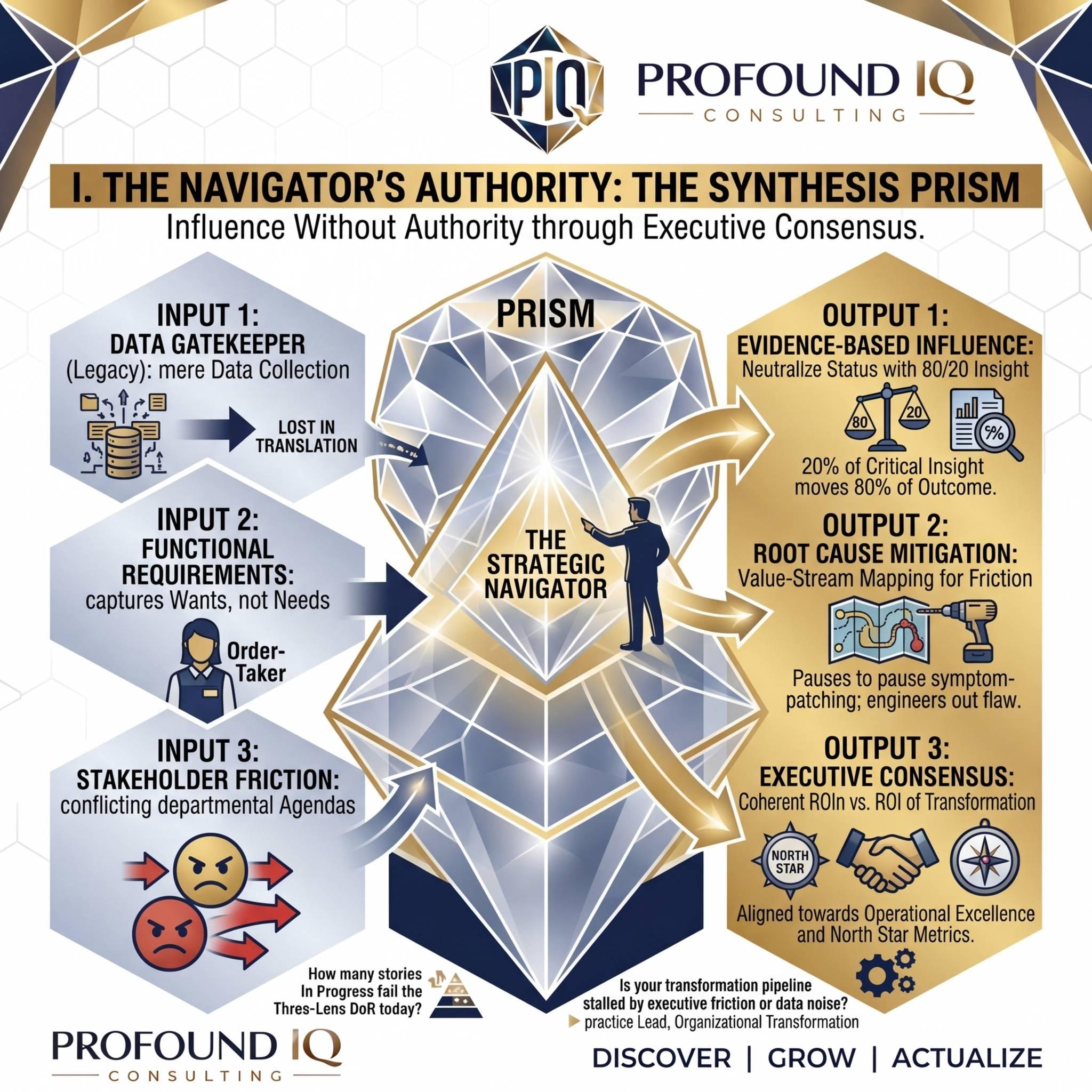
Synthesize, Don’t Standardize: The business doesn’t need a single view of the truth; it needs a shared understanding of the implications of the truth. A Navigator synthesizes customer behavioral data, financial forecasts, and operational capacity to project the Risk of Inaction (ROIn) versus the ROI of Transformation.
Evidence over Status: In the Profound IQ model, status is irrelevant; evidence is paramount. The BA uses the 80/20 Rule to protect executive time. They present the 20% of critical insights that drive 80% of the strategic outcome, making the optimal decision intuitive.
Root Cause Mitigation: Consensus is often held hostage by symptoms. The BA uses Value-Stream Mapping to identify and mitigate the root cause of friction (e.g., poor data cleanliness) rather than debating the symptom (e.g., an inadequate dashboard), pivoting the conversation toward the value-unlock.
Situation: The SPA Catering and Finance departments were at an impasse. Catering insisted on complex, custom “Global Flavor Palettes” to improve Customer Satisfaction (Desirability Lens), driving a 15% budget increase. Finance demanded a strict 10% budget cut, citing increased fuel costs (Viability Lens). Frictions were high, and consensus was zero.
The Navigator’s Intervention (Influence without Authority): A Profound IQ-trained BA ignored the demands for “more options” versus “less cost” and mapped the entire Value Stream of the catering supply chain.
80/20 Insight: The BA discovered that 80% of the catering budget was spent on the custom “Flavor Palettes.”
Root Cause: A data audit showed that 65% of that custom catering was discarded—a waste stream driven not by flavor preference, but by catering ordering based on obsolete flight-load forecasts. Transcription Tax had prevailed; stakeholders requested what they wanted, not what the value stream needed.
Consensus-Building Data Synthesis: The BA presented the Risk of Inaction (financial waste and crew friction) to the entire Executive team. By focusing the conversation on a unified North Star Metric—Waste Reduction Percentage—they achieved Strategic Alignment.
Consensus Outcome: The Executives agreed (consensus achieved) to a lean operational excellence synergy: Implementing an API for near-real-time forecast integration into the catering order system, coupled with a simplified 3-choice menu.
Consensus Result: Total catering waste reduced by 55%, capturing Finance’s desired budget cut and enabling reinvestment into consistent quality in the simplified menu, which improved Customer Satisfaction scores. Evidence, not opinion, won.
Consultant Call-out: The “Answer First” Principle of Authority
Pro-Tip: If your first slide for an executive presentation is a table of content, you have already ceded influence. True Influence Without Authority begins with the Answer First (The Pyramid Principle). Start with the recommendation for Root Cause Mitigation (Supported by the 80/20 Insight), then provide the supporting data. Never force an executive to synthesize your data for you.
The Challenge: KML, a Nairobi-based fintech, saw a 65% drop-off rate in their merchant loan application process. The initial request was for a “prettier UI.”
The Navigator’s Intervention: A Profound IQ-trained BA ignored the UI request and mapped the Value Stream. They discovered that the bottleneck wasn’t the “look” of the app, but a requirement for merchants to upload physical KRA (Kenya Revenue Authority) certificates—a task that took users 48 hours to complete.
The Solution:
80/20 Analysis: The BA realized that 80% of the “untrustworthy” applicants could be filtered using mobile money transaction history instead of KRA docs.
Strategic Alignment: By integrating a simple API to pull transaction data, KML achieved Operational Excellence.
Outcome: Onboarding time dropped from 2 days to 10 minutes. Conversion rates increased by 40% without a single change to the “UI aesthetics.”
Your value is no longer measured by the thickness of your documentation, but by the clarity of your insights. To navigate the future, you must stop being the person who takes the order and start being the person who defines the destination.
 Google
  Facebook