


Lesson Objective:
To rigorously define Emotional Intelligence, deconstruct its five core components, and explore the strategic application of these skills to enhance personal relationships, elevate professional dynamics, and fortify overall well-being and resilience.
Historically, professional and academic success was largely predicted by a single metric: the Intelligence Quotient (IQ). Today, behavioral science and organizational psychology recognize a more comprehensive framework for success, heavily reliant on Emotional Intelligence (EI or EQ).
Traditional Intelligence (IQ): This measures raw cognitive capacity—logic, spatial reasoning, mathematical capability, and linguistic processing. IQ is essentially the “processor speed” of the brain. It is largely considered fixed from early adulthood and represents the baseline competence required to enter a specific field or role.
Emotional Intelligence (EI/EQ): This is the dynamic capacity to recognize, understand, manage, and positively channel one’s own emotions, coupled with the ability to accurately perceive and influence the emotional states of others.
The Crucial Distinction: In professional environments, IQ is the qualifier—it gets you the job. EI is the differentiator—it dictates your trajectory. While IQ allows you to process complex data, EI enables you to communicate that data effectively, lead teams through ambiguity, and build enduring professional networks. Crucially, unlike IQ, EI is highly neuroplastic; it is a flexible, measurable skill set that can be strategically developed and refined over time.
Drawing on the seminal framework popularized by psychologist Daniel Goleman, Emotional Intelligence is not a monolithic trait but a composite of five mutually exclusive, collectively exhaustive (MECE) pillars.
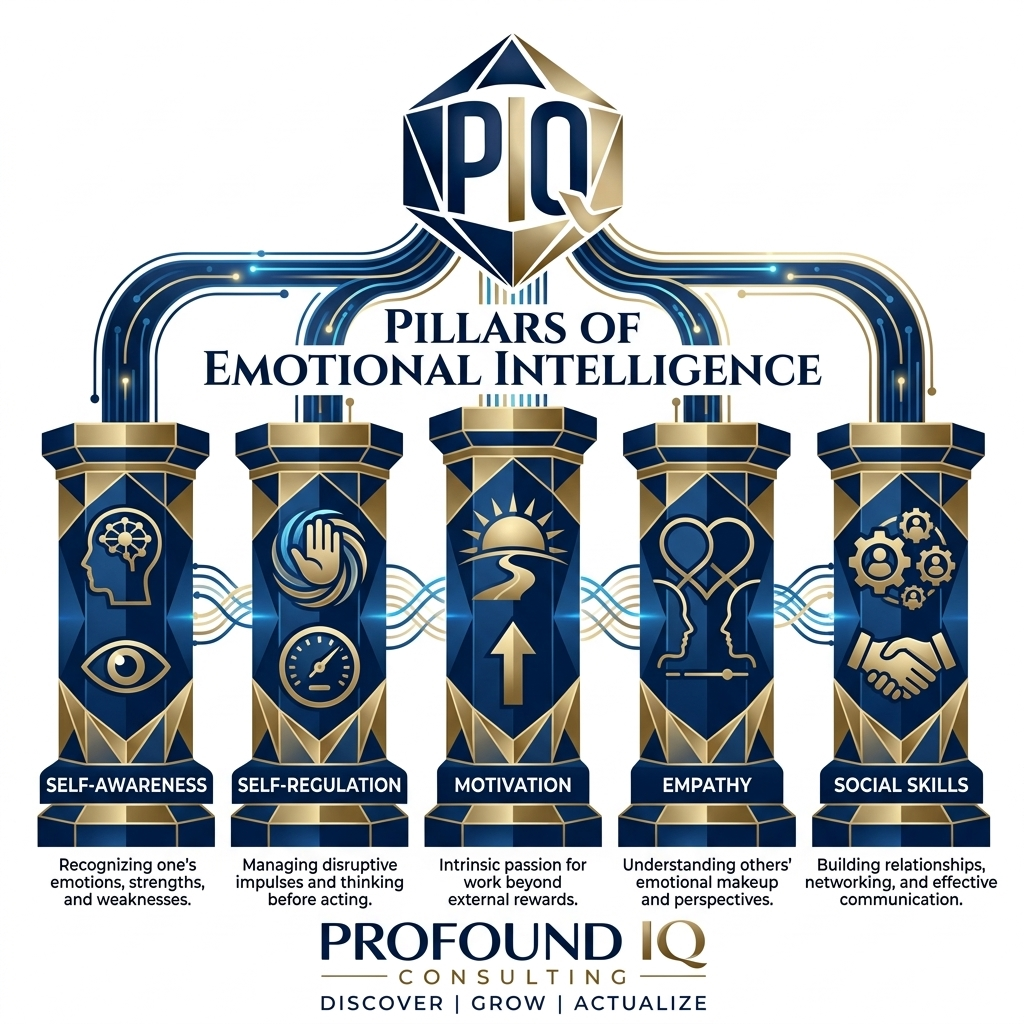
Self-awareness is the bedrock of all other emotional competencies. It is the real-time ability to monitor your internal state, recognizing your emotions, moods, and deep-seated drives as they occur. Furthermore, it involves a clear understanding of how these internal states impact your behavior, your decisions, and the people around you.
Sign of High Self-Awareness: Possessing a clear understanding of personal blind spots, accurately predicting your own emotional triggers, and demonstrating a willingness to seek out and absorb constructive, 360-degree feedback.
If self-awareness is identifying the emotion, self-regulation is choosing how to respond to it. It is the ability to suspend judgment, control disruptive impulses, and redirect unhelpful moods. It shifts behavior from reactive to proactive.
Sign of High Self-Regulation: Maintaining composure in high-stakes or volatile environments, embracing ambiguity without panic, and demonstrating the discipline to pause and process before initiating a difficult conversation.
In the context of EI, motivation refers specifically to intrinsic drive—a passion for the work itself that transcends external rewards like financial compensation or status. It is characterized by a strong drive to achieve for the sake of achievement, coupled with resilience in the face of setbacks.
Sign of High Motivation: Consistently pursuing goals with energy and persistence, maintaining an optimistic outlook during organizational shifts or failures, and showing a deep commitment to continuous capability growth.
Empathy moves EI from internal management to external awareness. It is the capability to understand the emotional makeup and specific perspectives of other people. It is not necessarily agreeing with someone, but rather comprehending their position well enough to interact with them strategically and compassionately.
Sign of High Empathy: Exceptional active listening skills, the ability to accurately read subtle non-verbal cues (micro-expressions, body language), and the capacity to tailor communication styles to the emotional needs of diverse stakeholders.
Social skill is the culmination of the previous four pillars applied to human interaction. It is proficiency in managing relationships, building deliberate networks, and navigating organizational politics with integrity. It is often described as “purpose-driven friendliness.”
Sign of High Social Skills: Excellence in cross-functional collaboration, the ability to build immediate rapport, effective conflict mediation, and the capacity to influence change and lead teams without necessarily relying on formal authority.
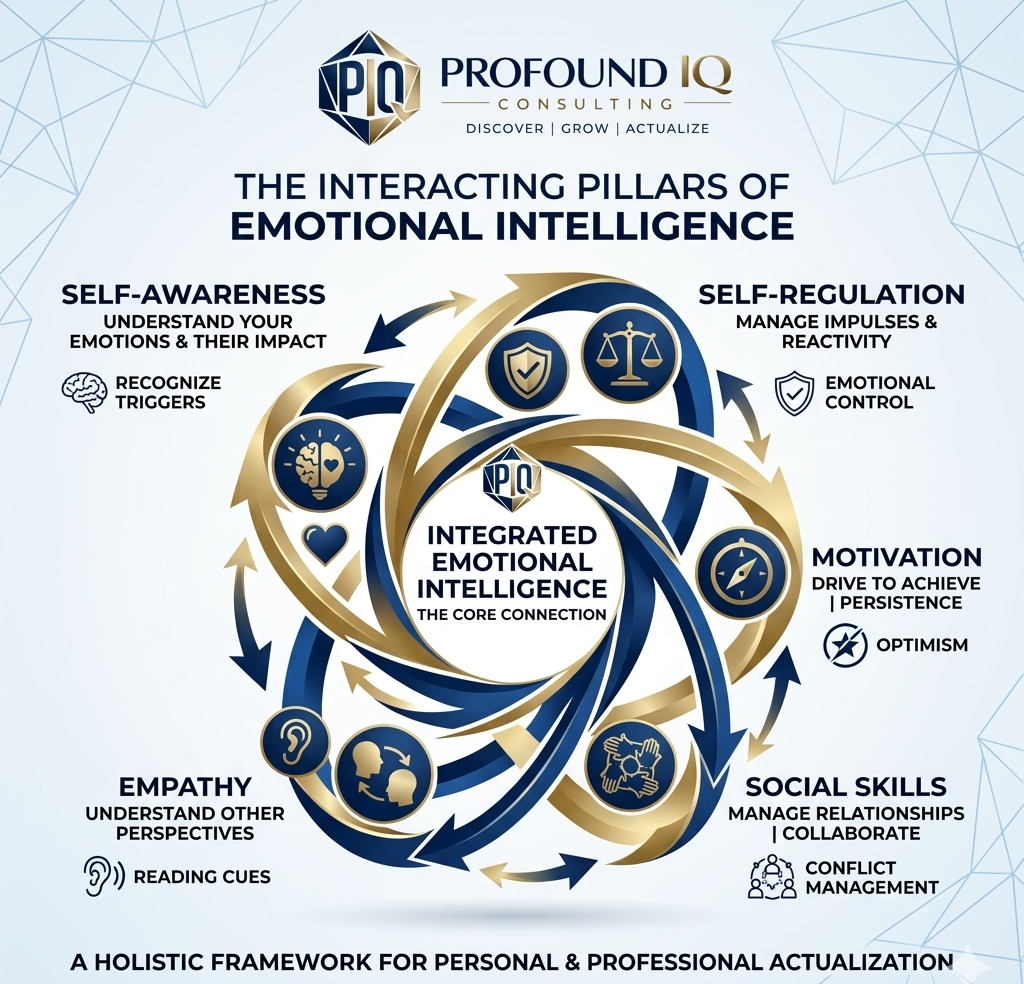
Emotional Intelligence acts as the operational friction-reducer in human interactions. It is the invisible architecture that dictates the effectiveness with which we navigate the social complexities, power dynamics, and interpersonal challenges of daily life. High EI transforms routine interactions from transactional exchanges into strategic relational investments.
At the individual level, EI is the difference between surviving a relationship and thriving within it. It provides the tools necessary to navigate the vulnerability of close connections.
Authentic Connection: Fosters deeper, more resilient bonds by ensuring both parties feel actively seen, heard, and understood. It moves interactions beyond surface-level pleasantries to cultivate a profound sense of mutual trust and psychological intimacy.
Boundary Management: Enables the confident establishment and maintenance of healthy, clear boundaries. High EI individuals can communicate their limits assertively yet empathetically, preventing long-term resentment without resorting to aggressive posturing or passive-aggressive withdrawal.
Constructive Conflict: Transforms destructive, ego-driven arguments into collaborative dialogues. It equips individuals with the ability to de-escalate tension, separate the person from the problem, and articulate unmet needs clearly without resorting to character assassination or defensive attacks.
In the corporate arena, EI is directly correlated with organizational health and operational efficiency. It is the competency that bridges the gap between individual talent and collective success.
High-Performing Teamwork: Fosters a culture of “psychological safety”—the critical prerequisite for high-functioning, innovative teams. In such environments, team members feel inherently secure in taking calculated risks, voicing dissenting opinions, and sharing unconventional ideas without the paralyzing fear of punitive judgment or professional backlash.
Advanced Conflict Resolution & Negotiation: Shifts the organizational paradigm from a zero-sum game of “winning” a departmental dispute to identifying mutually beneficial, synergistic solutions. High EI professionals excel at interest-based negotiation, focusing on underlying operational needs rather than digging into entrenched, ego-driven positions.
Transformational Leadership: Empathetic leaders inspire deep organizational loyalty and intrinsic motivation. By demonstrating genuine concern for their team’s well-being and professional trajectory, they drastically reduce employee turnover. Furthermore, they are equipped to navigate corporate crises, organizational restructuring, or periods of high volatility with a calm, stabilizing presence that mitigates widespread panic and keeps the workforce focused.
Strategic Stakeholder Management: Enables professionals to accurately “read the room” and decipher the broader organizational culture. This allows them to tailor their communication, anticipate resistance, and effectively influence diverse stakeholders to secure buy-in for complex initiatives.
Organizations and individuals that treat Emotional Intelligence as a core strategic competency—rather than a peripheral “soft skill”—observe measurable, compounding improvements. Cultivating a high EQ yields a robust Return on Investment (ROI) across human capital, driving performance, stability, and growth in three critical domains:
High EI acts as a sophisticated cognitive filter, stripping away the operational “static” of ego, defensiveness, and personal bias from interpersonal exchanges.
Active vs. Passive Listening: Practitioners develop the discipline to listen entirely to comprehend underlying drivers and concerns, rather than merely waiting for their turn to deploy a rebuttal.
Decoding the Unsaid: High EQ professionals become adept at reading non-verbal cues and subtext, allowing them to address unspoken anxieties or resistance before they escalate into formal conflicts.
Operational Clarity: This mastery translates directly to operational efficiency. It drastically reduces costly misunderstandings, facilitates the crystal-clear delegation of complex initiatives, and empowers leaders to navigate high-stakes negotiations with agility and nuance.
In volatile or high-pressure business environments, unchecked emotional responses invariably lead to impulsive, biased, or critically shortsighted decisions.
The Internal Gap Analysis: High EI equips professionals with the capacity to execute a rapid internal diagnostic. When triggered by stress, frustration, or ambiguity, they deploy a “strategic pause.” This allows them to acknowledge their immediate emotional state, neutralize the inherent cognitive bias, and consciously engage the rational executive function of the brain.
Long-Term Alignment: Decisions are subsequently made based on alignment with long-term organizational targets rather than the desire for short-term emotional relief.
Empathetic Change Management: Empathetic decision-making proactively considers the human impact of strategic shifts. By anticipating how a decision will affect team morale and workflow, leaders can mitigate stakeholder resistance and drastically improve the success rates of change implementation.
In demanding corporate landscapes, poor emotional regulation is the primary catalyst for chronic stress, workplace anxiety, and the costly epidemic of employee burnout.
The Psychological Buffer: High EI serves as a vital psychological shield against environmental stressors. It prevents the internalization of external chaos.
Cognitive Resilience: It cultivates the agility to rapidly rebound from inevitable failures, market shifts, or project setbacks—often referred to as a high “bounce-back rate”—without losing professional momentum or confidence.
Proactive Recalibration: Crucially, it fosters the deep self-awareness required to recognize the early, subtle indicators of cognitive fatigue. This empowers leaders and teams to strategically mandate rest or recalibration, transforming a culture of exhaustive “hustle” into a sustainable framework for long-term, high-yield performance and top-tier talent retention.
The true value of Emotional Intelligence lies not in conceptual understanding, but in behavioral execution. Transitioning from a theoretical framework to habitual, real-world application requires deliberate, structured repetition. The following protocols are designed as cognitive training exercises to seamlessly integrate EI competencies into your daily workflow.
You cannot effectively manage what you do not accurately measure. This exercise is designed to gather baseline data on your emotional patterns, helping you identify blind spots and psychological triggers before they dictate your behavior.
The Action (Data Collection): Set three random, unlabelled alarms on your phone or smartwatch during your typical workday. When the alarm sounds, execute a “hard pause”—stop typing, stop speaking, and take one deep breath.
The Reflection (Analysis): Immediately document the following in a dedicated journal or digital note:
Precise Identification: What exact emotion am I experiencing right now? (Move beyond “stressed” or “fine” to more granular terms like “defensive,” “overwhelmed,” or “energized”).
The Catalyst: What specific event, interaction, or upcoming deadline triggered this state?
The Physiological Footprint: How is this emotion manifesting physically? (e.g., shallow breathing, tension in the jaw, elevated heart rate).
The Cognitive Impact: How is this state currently impacting my focus and the quality of my judgment?
The Strategic Objective: Over a two-week period, this daily audit will disrupt your brain’s “autopilot” mode, building the neuro-pathways required for real-time self-awareness.
When exposed to a high-stress trigger, the human brain often experiences an “amygdala hijack”—where the emotional center overtakes the rational, executive center (the prefrontal cortex). The Strategic Pause is a tactical mechanism to prevent this bypass.
The Action (Implementation): For the next 48 hours, commit to a strict, non-negotiable 3-second delay before responding to any communication that triggers a negative emotional spike.
Asynchronous: If reading a frustrating email, physically step away from the keyboard for 3 seconds before drafting a reply (or better, leave it in drafts for an hour).
Synchronous: In a tense meeting, take a slow breath and count to three before answering a challenging or aggressive question.
The Reflection (Observation): Observe how inserting that brief, deliberate gap between stimulus and response alters the dynamic.
Notice the shift from a defensive reaction to a calculated, strategic response.
Evaluate how this pause impacts the professionalism, tone, and ultimate effectiveness of your communication.
In business, we routinely conduct post-mortems on failed projects. We rarely apply this same rigorous analysis to failed human interactions. This prompt serves as a structured retrospective for conflict resolution.
The Action: Select a recent professional or personal conflict that did not resolve favorably (e.g., a derailed negotiation, a tense team meeting, an argument at home).
The Diagnostic Prompt: Conduct a brutally honest internal gap analysis by answering the following:
The Reality Gap: What was the actual outcome versus your desired objective?
The Empathy Deficit: What were the other party’s likely unstated pressures, underlying fears, or core drivers that you failed to acknowledge or validate during the exchange?
The Reactivity Tax: How did your own lack of self-regulation (e.g., raising your voice, interrupting, shutting down) escalate the friction or extend the conflict?
The Strategic Pivot: If given a “do-over,” what specific words, tone adjustments, or empathetic listening techniques would you deploy to close the gap and achieve a synergistic outcome?
Adaptability over Fixed Capacity: Emotional Intelligence (EI) is the critical ability to manage your own emotions and strategically navigate the emotions of others. Unlike IQ, it is a highly developable competency.
The Five Pillars: The framework relies on mastering Self-Awareness, Self-Regulation, Motivation, Empathy, and Social Skills.
The Ultimate Differentiator: High EI is not merely a “soft skill”; it is a hard requirement for sustained success. It is directly correlated with superior leadership capabilities, more resilient relationships, optimal decision-making, and significantly reduced stress levels.
 Google
  Facebook